By the TopStraps team · Updated September 2026
Quick answer: To measure lug width, remove the strap and measure the distance between the inside edges of the lugs with calipers or a millimetre ruler. Most watches measure a whole number of millimetres, usually between 16mm and 24mm, and both even and odd sizes are normal (19mm, 21mm and 23mm are common on luxury watches). If you get a half size such as 19.5mm, remeasure or check the size stamped on your old strap.
What You Need to Measure Lug Width
All you need is a pair of calipers or a ruler marked in millimetres, plus a soft cloth to rest the watch on. Precision matters here: even 1mm off can result in a strap that doesn’t fit.

- Calipers (digital or vernier): the most accurate option, because the jaws sit directly against the inside of the lugs.
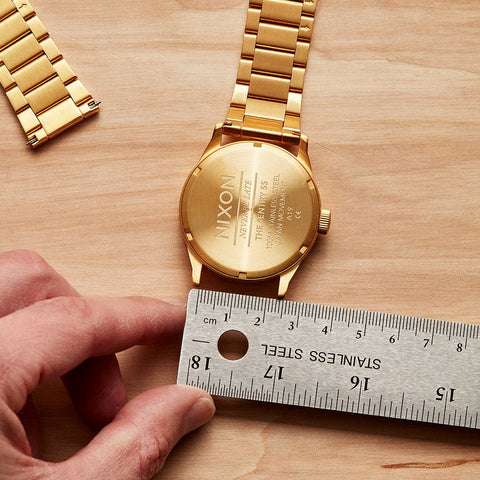
- Millimetre ruler: works well if you read it at eye level and line up the zero mark exactly with one lug.
- Our printable sheet: use our handy printable sheet to measure your watch lugs if you don’t have a ruler to hand. Print it at 100% scale so the markings stay accurate.
How to Measure Lug Width, Step by Step
Measure the inside distance between the lugs with the strap removed, then check the result a second time before you order.
- Prepare your watch: remove the strap and place the watch face-down on a soft, flat surface so it can’t slide or get scratched.
- Position your tool: place one caliper jaw (or the zero mark of your ruler) against the inside edge of one lug, at the height where the spring bar sits.
- Read the distance: close the calipers against the inside edge of the opposite lug, or read the ruler where it meets that lug.
- Measure again: repeat the measurement at least once, holding the tool level with the lugs rather than at an angle.
- Sense-check the number: the result should be a whole millimetre. If it isn’t, see the section on measurements that fall between sizes below.

Once you’ve confirmed your measurement, you’re ready to select the perfect strap.
How to Measure Your Existing Watch Band
If you have a strap that fits well, check its underside first: many straps have their width printed or stamped there. If there is no marking, measure the strap straight across at the end that attaches to the watch, not at the buckle end.
This matters because many straps are tapered, meaning they are wider at the lugs and narrower at the buckle (for example 22mm at the lugs and 20mm at the buckle). Only the lug-end width tells you your lug width.
Common Mistakes to Avoid
Most sizing errors come from measuring the wrong part of the watch or strap, or from rounding a measurement instead of rechecking it.
- Measuring the outside of the lugs: always measure the inside distance where the strap actually sits, not the outer edge of the case.
- Measuring a strap at the buckle end: on a tapered strap this gives a smaller number than your real lug width.
- Guessing based on case size: a 40mm case doesn’t tell you the lug width, and two watches with identical case diameters can take different strap widths.
- Rounding up “just in case”: a strap even 1mm too wide will not seat properly between the lugs.
- Measuring at an angle: a tilted ruler or caliper reads wider than the real gap.
What to Do If Your Measurement Falls Between Sizes
If your calipers show something like 19.5mm, don’t round up or down: remeasure. Most lug widths are a whole number of millimetres, and both even and odd sizes are common (19mm, 21mm and 23mm are widely used on luxury watches), so a half-millimetre result usually means a small measuring error.
Measure again with the watch resting flat and the calipers held level with the lugs. If you’re still unsure, the size stamped on the underside of your current strap is often the fastest way to confirm.
Why Getting Lug Width Right Matters
Lug width decides whether a strap will physically fit between the lugs at all. A strap that’s too wide can’t be forced into place without damaging the spring bar or the case, while one that’s too narrow leaves visible gaps and can shift on the wrist. Unlike strap length, where adjustable buckles give you some leeway, lug width has to be exact.
After Measuring: Check Your Size Against the Size Guide
Once measured, use our watch band size guide to check your number against typical lug widths by watch type and to pick the right strap length for your wrist. Most watches fall between 16mm and 24mm, but your own measurement is always the number to trust.
With your exact lug width confirmed, you can browse our full collection of watch straps filtered by size, so every option shown fits your watch.
Frequently Asked Questions
What’s the best way to measure watch lug width?
Use calipers or a millimetre ruler to measure the distance between the inside edges of your watch’s lugs, with the strap removed and the watch resting on a soft, flat surface. This inside-to-inside measurement is what determines which strap widths will actually fit.
What tools do I need to measure lug width?
Digital or vernier calipers give the most accurate reading, but a ruler marked in millimetres also works if you read it carefully at eye level. You can also use our printable measuring sheet.
Can I use my existing strap to figure out my lug width?
Yes. Many straps have their width stamped on the underside, so flip your current strap over and check before reaching for a ruler. If there is no marking, measure the strap across the end that attaches to the watch, not the buckle end.
Should I measure a tapered strap at the lug end or the buckle end?
Always at the lug end. Many straps narrow towards the buckle, for example from 22mm to 20mm, so a buckle-end measurement will make your lug width look smaller than it is.
What happens if I get the lug width wrong?
A strap that’s too wide can’t be forced between the lugs without risking damage to the spring bar or case, while a strap that’s too narrow leaves visible gaps and can shift out of position on the wrist. Unlike strap length, lug width has to be exact.
My measurement came out as a half-millimetre, like 19.5mm — what should I do?
Remeasure before ordering. Most lug widths are a whole number of millimetres, so a half-millimetre result usually means a small measuring error. Try again with the watch flat and the calipers held level with the lugs, or check the underside of your current strap for a stamped size.
Once you know your lug width, our guide to watch straps helps you choose the right material and find the strap guide for your watch brand.