By the TopStraps team · Updated September 2026
Quick answer: To choose a watch strap, first measure the gap between your watch’s lugs in millimetres. That number is the strap width you need. Next, pick the material for how you wear the watch: leather for dress, silicone or FKM rubber for water and sport, nylon or canvas for heat and travel, and a steel bracelet for all-round durability. Finally, check the length against your wrist. This guide covers each step and links to our strap guides for every major watch brand.
How to Choose the Right Watch Strap Size
The right strap size is the inside distance between your watch’s lugs, measured in millimetres. Take the old strap off, then measure between the lugs with a caliper or a millimetre ruler. Common widths are 18, 20, 22 and 24mm, but odd sizes like 19, 21 and 23mm are more common on luxury watches than many people expect. The strap should match that width exactly; even 1mm too narrow leaves a gap and lets the strap shift on the spring bars.
Many straps taper towards the buckle, for example from 22mm at the case to 20mm at the buckle. Always choose by the width at the lugs. For a step-by-step method with photos, see how to measure your watch lug width and our watch band size guide.
Strap length
Strap length is given as two numbers: the long side (with the holes) and the short side (with the buckle). As a general guide:
| Wrist size | Typical strap length (long + short) |
|---|---|
| Small | around 110–115mm + 70–75mm |
| Average | around 120mm + 75–80mm |
| Large | around 125–130mm + 80–90mm |
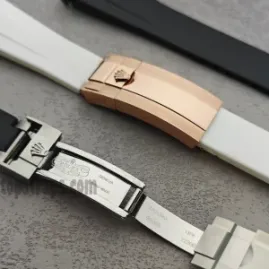
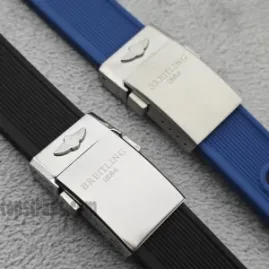
A folding or deployant buckle adds length of its own, so straps made for folding buckles are often shorter on paper. On integrated designs such as the Royal Oak, Nautilus or Tissot PRX, the strap end is shaped to the case, so it has to be made for that exact model rather than chosen by width alone.
Watch Strap Materials Compared
The best strap material depends on how and where you wear the watch, and no single material wins on every count. The table below compares the main options honestly.
| Material | Water & sweat | Comfort in heat | Dress or sport | Break-in | Main downside |
|---|---|---|---|---|---|
| Leather | Poor | Fair | Dress, smart-casual | Softens over weeks | Absorbs sweat and water; wears out fastest in daily summer use |
| Silicone rubber | Excellent | Good | Sport, casual | None | Can attract lint and lose shape over the years |
| FKM (fluoro) rubber | Excellent | Good | Sport, smart-casual | Slightly stiff at first | Costs more than silicone |
| Nylon / canvas | Good (dries fast) | Very good | Casual, travel | None | Looks too casual for formal wear; can hold dirt |
| Steel bracelet | Excellent | Fair (heavier) | Both | None | Heaviest option; needs link sizing and can scratch |
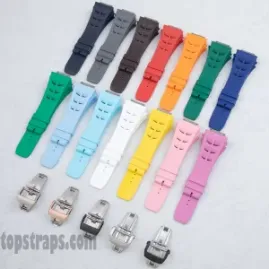
Leather is the most elegant choice and moulds to the wrist, but it does not like water. Rubber is the practical choice for swimming, the gym and hot weather. Nylon and canvas are the lightest and most breathable. A steel bracelet is the most versatile and lasts the longest, but it is also the heaviest. Many owners keep two: a bracelet or leather strap for the office, and rubber for summer.
Silicone vs FKM Rubber: What’s the Difference?
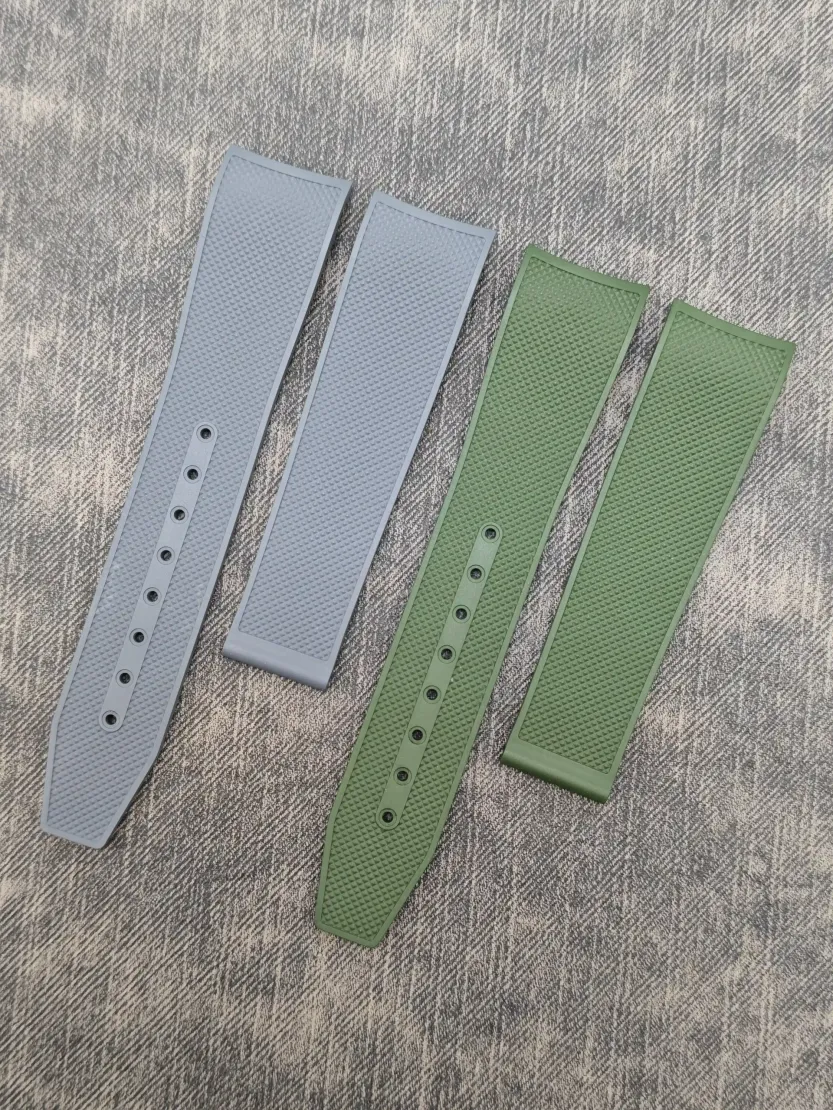
FKM (fluoro rubber) is a denser, more resistant material than standard silicone, and silicone is the softer and cheaper of the two. Silicone is comfortable from the first day and needs no break-in. FKM holds its shape and colour better under sun, salt water, chlorine and sunscreen, and it doesn’t collect lint or turn sticky over time. The trade-off is a slightly firmer feel for the first few days.
| Silicone | FKM rubber | |
|---|---|---|
| Feel out of the box | Very soft | Firmer, softens with wear |
| Resistance to UV, salt, chlorine | Good | Very good |
| Lint and dust | Attracts some | Stays clean |
| Keeps shape and colour | Good | Very good |
| Price | Lower | Higher |
| Best for | Everyday comfort, occasional swimming | Heavy sun, sea and pool use; long-term wear |
How to Change a Watch Strap at Home
You can change most watch straps at home in a few minutes with a spring bar tool. Here is how:
- Prepare the workspace. Place the watch face down on a soft cloth. There is never any need to open the case back to change a strap.
- Release the spring bar. Use the forked end of a spring bar tool to push the bar inward and ease the strap out of the lug. Repeat on the other side.
- Fit the new strap. Put the spring bars into the new strap, set one end of the bar into its lug hole, compress the other end and let it click into place.
- Check the fit. Tug each end gently to make sure both spring bars are fully seated.
Quick-release straps have a small lever on the spring bar, so they can be changed without tools. Some watches use screws or brand-specific systems rather than spring bars. Our brand guides below explain those cases, for example changing a Hublot strap or replacing a Rolex Oysterflex-style band.
How to Care for Each Strap Material
Each material needs different care, and following it makes the strap last noticeably longer.
- Leather: Keep it away from water, showers and workouts. Let it air out after hot days, wipe it with a slightly damp cloth, and condition it every few months. Test the conditioner on the underside first.
- Silicone and FKM rubber: Rinse in fresh water after the sea or the pool, and wash now and then with mild soap.
- Nylon and canvas: Hand-wash in lukewarm soapy water and let the strap dry flat before putting it back on the watch.
- Steel bracelets: Clean between the links with a soft brush, warm water and mild soap, then dry thoroughly. After salt water, rinse so salt doesn’t build up in the links.
Strap Guides by Watch Brand
Every brand has its own lug widths, case shapes and strap systems, so we have written a dedicated guide for each one. Start with your brand below.
We also make straps for Vacheron Constantin, Cartier, Bvlgari, Oris, Seiko, Porsche Design and other brands. All TopStraps products are aftermarket straps made to fit these watches.
FAQ
How do I know what size strap my watch needs?
Measure the inside distance between the lugs in millimetres. The strap must have exactly that width where it meets the case.
Which strap is best for swimming and workouts?
Rubber is best: silicone for everyday comfort, or FKM for heavy sea, pool and sun use. Nylon also works because it dries quickly. Avoid leather in water.
Is FKM rubber better than silicone?
FKM is more durable and keeps its shape and colour better, while silicone is softer from day one and costs less. For heavy water and sun exposure, choose FKM. For comfort on a budget, choose silicone.
Can I change a watch strap myself?
Yes. Most straps use spring bars and can be changed in minutes with a spring bar tool, or without tools if they have quick-release bars. You never need to open the watch case.
How often should I condition a leather strap?
Every few months, or sooner if the leather looks dry. Keep leather away from water and let it air out after hot days.