By the TopStraps team · Updated September 2026
Quick answer: A watch band size has two parts: the width, which must match your watch’s lug width exactly (most watches are between 16mm and 24mm), and the length, which is chosen by wrist size. Length is usually written as long side / short side, for example 120/75mm, measured without the buckle. Use the charts below to check both before you buy.
Two-piece watch bands are sized by the width of the strap where it connects to the watch, always measured in millimetres (mm), and by their length.
Watch Band Size Chart: Strap Length by Wrist Size
Most people with a wrist of roughly 16–19cm can wear a standard-length strap; smaller wrists usually need a short strap and larger wrists a long one. The table below is an approximate guide, since the right length also depends on your watch case size and how snug you like the fit.
| Wrist circumference | Strap length to look for | Typical total length (excluding buckle) |
|---|---|---|
| Under about 16cm | Short | Around 180mm or less |
| About 16–19cm | Standard | Around 190–200mm (e.g. 120/75mm) |
| About 19–21cm | Long | Around 205–215mm |
| Over about 21cm | Extra long | Around 220mm or more |
If you already own a strap that fits well, its length is the most reliable guide: choose the same or a similar length.
How Watch Strap Length Is Written
Strap length is usually written as two numbers, the long side followed by the short side, for example 120/75mm. The long side is the piece with the holes; the short side is the piece that carries the buckle.
Strap lengths are always measured excluding the buckle. Some listings give only the combined total (120 + 75 = 195mm), so check which figure you are comparing.
Common Lug Widths by Watch Type
Most watch lug widths fall between 16mm and 24mm, and both even and odd sizes are common. Use this chart to sense-check your measurement; the ranges are typical, so always measure your own watch before ordering.
| Lug width | Typically found on |
|---|---|
| 16–18mm | Smaller dress watches and many women’s watches |
| 19–20mm | Classic dress and sport-dress watches, including many Rolex and Omega references |
| 21mm | Select Rolex and Omega references, including some Datejust and Seamaster models |
| 22mm | Divers and larger sport watches |
| 24mm and above | Oversized cases such as Panerai Luminor |
If your measurement falls between two whole numbers, remeasure before ordering: a strap that’s too wide will not seat correctly between the lugs.
Buckle Width vs. Lug Width
Lug width is the strap’s width where it meets the watch case; buckle width is its width at the buckle end, and the two are often different. Many straps taper, for example from 20mm at the lugs to 18mm at the buckle.
Only the lug width has to match your watch. The buckle width matters if you want to reuse your existing buckle or deployant clasp, which has to match the strap’s buckle-end width.
How to Find Your Lug Width
Check the inside of your current strap for a printed size, or measure the distance between the inside edges of the lugs in millimetres. For tools, step-by-step instructions and common mistakes, see our guide on how to measure lug width.


How to Find Your Strap Length
Find your strap length by measuring an old strap that fits well, or by measuring your wrist and using the chart above. Taking a few minutes to check can save you the frustration of buying the wrong size.
Measure Your Old Strap

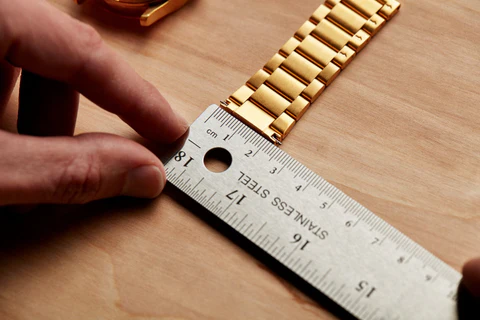
Measure each side of the strap in millimetres and add them together for the total length, without including the buckle. If your current strap fits well, choose a strap of the same or similar length. If it’s too long or too short, look for a longer or shorter model.
Measure Your Wrist

Wrap a seamstress tape around your wrist where you wear your watch. If you don’t have one, wrap a strip of paper around your wrist, mark where it overlaps and measure it against a ruler.
Remember to account for the width of your watch case when working out the total strap length required. Also keep in mind that two-piece straps can be adjusted smaller when buckled, so it’s fine if the strap is slightly longer than necessary.

One-Piece vs. Two-Piece Straps: Sizing Differences
Sizing depends on the strap format: two-piece straps need a matching lug width and a suitable length, while one-piece and fitted straps have stricter requirements.
Two-piece straps (the traditional style with a buckle) only need the lug width and a length that comfortably fits your wrist, since the buckle allows for adjustment across several holes.
NATO and single-pass straps use one continuous piece of material that threads through both sets of lugs, so length matters more here: too short and it won’t wrap around a thicker wrist, too long and there will be excess material to tuck away.
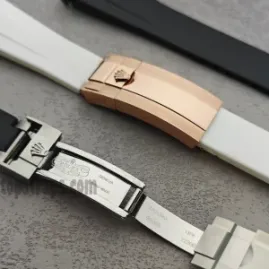
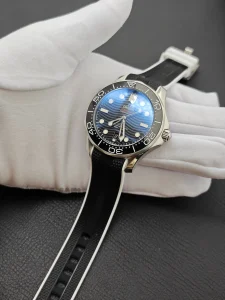
Rubber and integrated straps, such as those shaped for specific Rolex, Omega or Panerai references, are made to match the case precisely, so lug width and case model both need to match exactly. There is little room for “close enough.”
What Happens If You Choose the Wrong Size?
A wrong width is a real problem, while a wrong length is usually easier to live with. A strap even 1mm too narrow leaves visible gaps beside the lugs, and one that’s too wide won’t fit between them at all. Most two-piece straps have several adjustment holes, but an overly long strap can look sloppy and an overly short one may not close comfortably around a larger wrist.
Don’t guess from your watch’s case diameter: case size and lug width are not directly related, and two watches with the same case diameter can take different strap widths.
Quick Reference: Sizing Checklist Before You Buy
Before ordering, confirm these five points:
- Lug width in millimetres, measured from the inside edges of the lugs.
- Whether the strap tapers, and the buckle-end width if you plan to reuse a buckle or clasp.
- Total strap length in millimetres, excluding the buckle.
- Your wrist size and preferred fit (snug vs. relaxed).
- The strap style (two-piece, NATO, or fitted rubber) that suits your watch model.
Once you have these numbers, you can browse our full range of watch straps and bracelets filtered by width, so you only see options that fit your watch.
Frequently Asked Questions
What size watch band do I need?
You need two numbers: the width, which must match your watch’s lug width exactly, and a length that suits your wrist. Most wrists fit a standard-length strap; very small or large wrists may need a short or long version.
How is watch strap length written?
Strap length is usually written as two numbers, such as 120/75mm: the first is the long side with the holes, the second is the short side with the buckle. Both are measured excluding the buckle.
How do I know what strap length I need?
If you have an average-sized wrist, a standard-length strap should fit well. For larger or smaller wrists, you may need an extra-long or extra-short strap. Measuring your wrist or an existing strap can help you choose the right length.
How do I measure my wrist for a new strap?
Wrap a seamstress measuring tape around your wrist where you wear your watch. If you don’t have one, use a strip of paper, mark where it overlaps and measure it against a ruler. Remember to account for the size of the watch case.
Is buckle width the same as lug width?
Not always. Many straps taper, so the buckle end is narrower than the lug end, for example 20mm at the lugs and 18mm at the buckle. The lug width must match your watch; the buckle width only matters if you want to reuse an existing buckle or clasp.
Does the strap need to fit exactly?
The width does, but the length doesn’t. Two-piece straps are adjustable when buckled, so it’s fine if the strap is slightly longer than required.
Once you know your size, our complete guide to watch straps helps you choose the right material and find the strap guide for your watch brand.
Ο καρπός μου είναι xxl
Περιμένω νέα σας .
Εχω άλλη μια ερώτηση που θα έρθει το δέμα ;
Και πόσες μέρες θα κάνει .
Ευχαριστώ περιμένω νέα σας.